How turbocharger design is changing as car firms chase efficiency
For a component whose future is so closely tied to that of the combustion engine, the pace of technological development on turbochargers is extraordinary. From integrated manifolds with twin scroll and dual volute designs with variable geometry, to electric turbochargers, here are the latest developments.
According to Tobias Jakobi, Global Product Manager Face Milling at Seco Tools, there are two big factors driving the growing complexity of turbocharger design: pressure to reduce the size and weight of engines to increase fuel efficiency, and the rise of hybrid cars.
"The downsizing of the volume of the cylinders is a trend that has been ongoing for the past 10 years, but the rise of hybrid car technologies is currently boosting that a lot," he explains. Some hybrids have engines as small as 0.65 litres and car manufacturers are now bringing engine sizes below 1 litre for even non-electric vehicles, while still seeking to provide up to 200hp. "A turbocharger can have a really tremendous impact on making that possible," Jakobi says.
Turbochargers improve fuel efficiency by using a car's exhaust gases to spin a turbine, which then pumps air into the engine's cylinders.
The role of the exhaust manifold
The challenge today is that smaller engines mean less exhaust to drive the turbine, meaning designers have to do everything they can to make sure that the gases still produce the same pressure on the turbine wheel and make it run at the same speed.
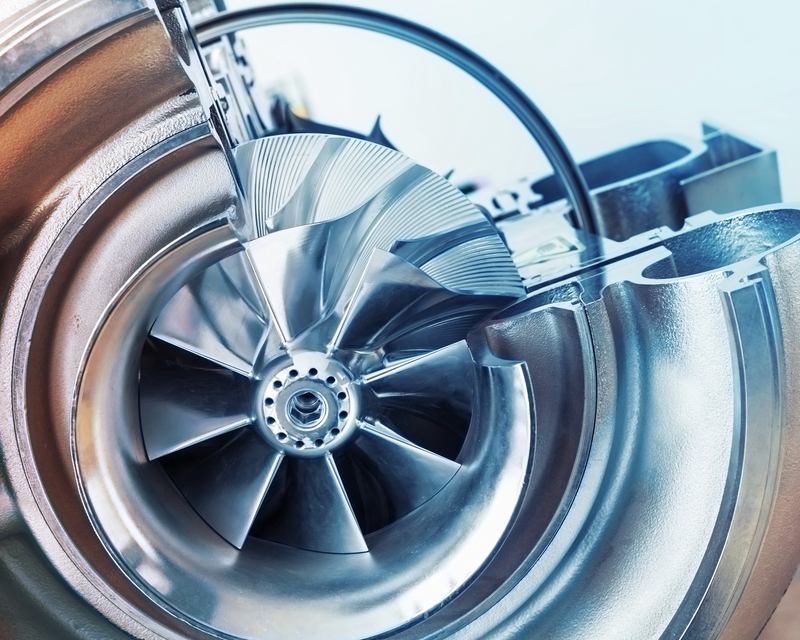
Turbocharger componentAchieving this begins at the exhaust manifold, which now must be integrated with the turbocharger in a single piece of metal, so that the reduced volume of exhaust gases is steered as efficiently as possible to the turbine.
"It's a really smooth transition from all around the turbo at the flange into the housing," Jakobi says of integrated manifold. "You can't get such a smooth transition if it's two parts that need to be joined."
Next, the manifold typically needs to have two separate channels for different groups of cylinders, which then deliver the gases into the turbine through two separate inlets, or "scrolls". It is also common to have two channels, or “volutes”, inside the turbine housing to deliver the gases to opposite sides of the turbine.
"You split up the channel of the hot gas so you get two different pressure points on the turbine to get a smoother transition, to keep cross-section pressure points, and more homogeneous pressure over time," Jakobi explains.
A twin-scroll, dual-volute design with an integrated manifold is a near requirement for turbochargers which feature ‘cylinder deactivation’, when one or more cylinder stops firing when cruising to lower fuel consumption. They are also made necessary by the higher compression ratios of modern engines, which save fuel, but make it even more important that exhaust gases hit the turbines at the precise spots.
High performance at low revs
Today’s designers are also seeking to improve performance at low Revolutions Per Minute (RPM), by making the blades of the turbocharger adjustable.
These so-called ‘variable geometry’ turbochargers have a minimum amount of lag, provide extra power at low RPMs, and also have greater efficiency at higher engine speeds.
They also seek to make turbochargers work well at both high and low RPMs by including a ‘wastegate’, which releases gases from the turbine when pressures get too high to prevent the turbine overloading.
Challenges for manufacturing
Every one of these design features create challenges for manufacturing.
The organic shapes of integrated manifolds are more complex to tool, and particularly to clamp, meaning more issues with vibrations. To withstand higher temperatures, they are often made of advanced alloys with a greater amount of heavy metals, which are both heavier and more wearing on tools. Manufacturers then compensate for the increased weight of the turbine by reducing the cross-section, requiring ever more precision.
Variable geometry typically means a bigger turbo housing, while the wastegate deep inside the turbocharger can be difficult to reach.
The rise of e-turbos
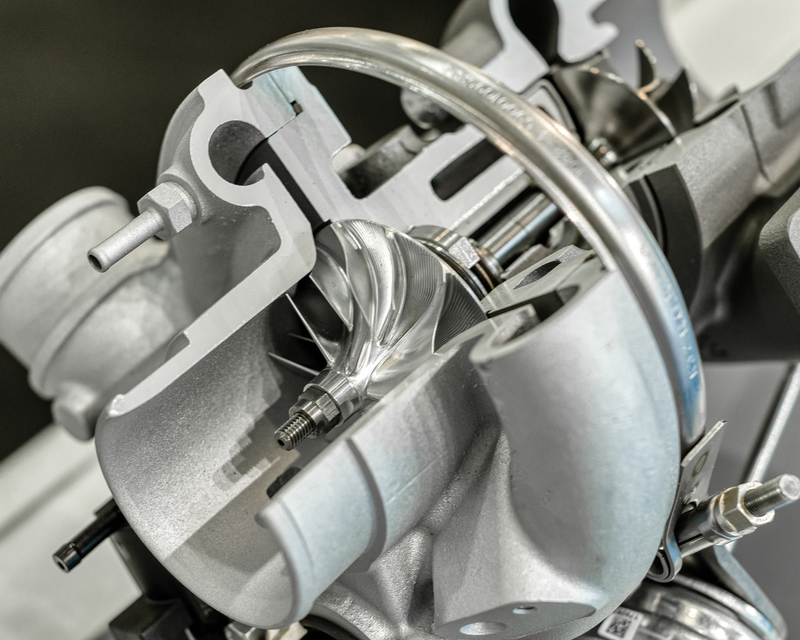
While the design features above are becoming much more common in modern turbochargers, none of them are new. The real cutting-edge developments today are around electric turbochargers, or e-turbos. Turbocharger component
With an e-turbo, the turbocharger is assisted with a small electric motor, which is either attached to the turbo shaft between the turbine wheel and the compressor wheel, or else located in a gas by-pass on the compressor side.
As well as giving an added boost, e-turbos can compensate for gaps in the supply of compressed gas from the engine, leading to smoother performance.
"E-turbos are really the new trend because they can boost performance significantly, especially on hybrid cars," Jakobi says.
"They are thinking about having up to eight electric turbos in one car, or putting an e-turbo on each cylinder. There are some really crazy ideas going on."